As Google nears 250 M&A deals since its YouTube acquisition back in 2006, we visualize the tech giant’s top acquisitions.
Over 12 years ago, tech giant Google announced its largest acquisition since it incorporated in a Menlo Park garage, paying $1.7B for YouTube, a video platform that at the time had fewer than 100 employees.
Since then, Google’s checkbook has opened wide (as we highlighted in our deep dive into Google’s M&A strategy), with 245+ M&A transactions announced over the past decade.
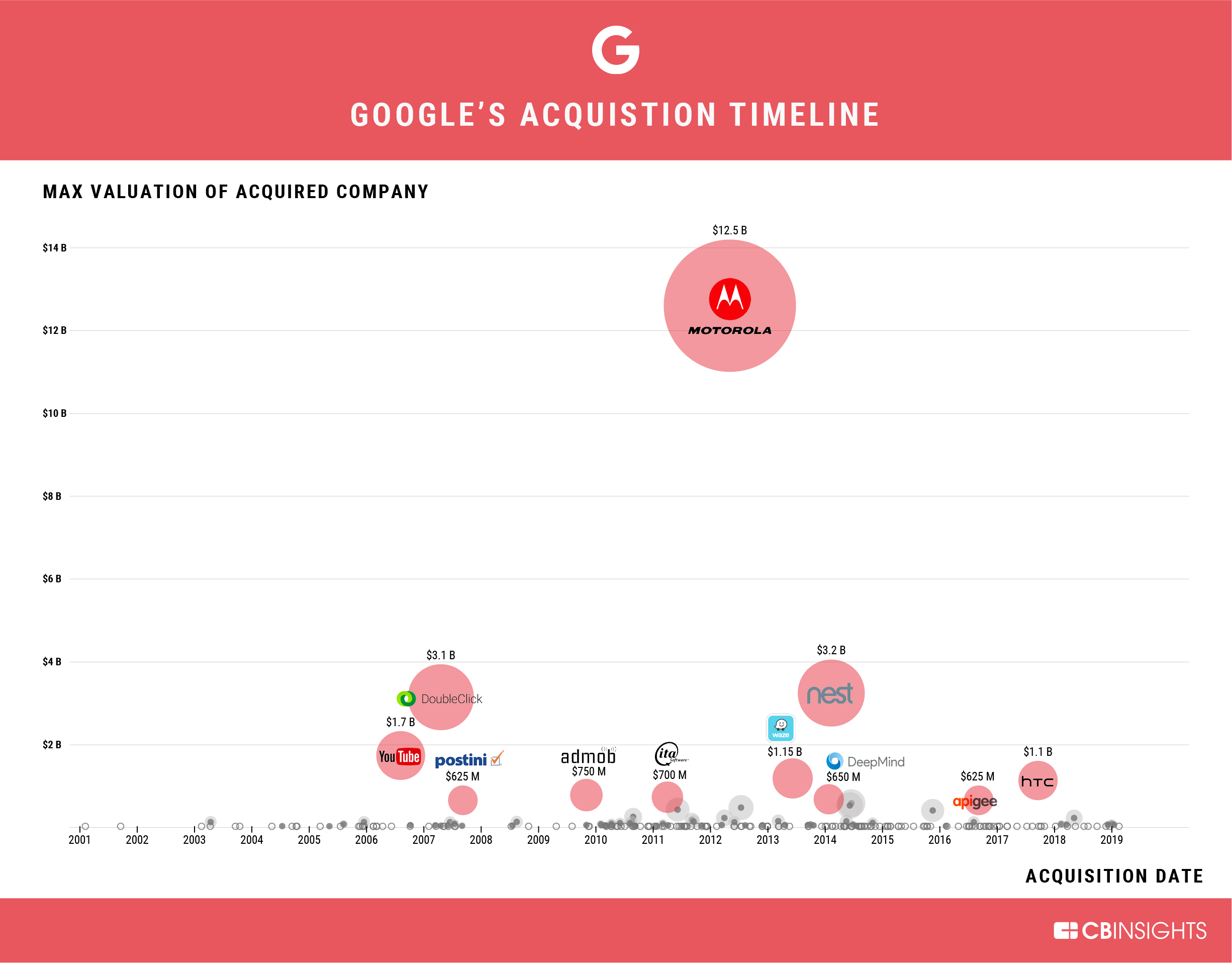
GOOGLE’S TOP ACQUISITIONS
1. Motorola Mobility ($12.5B, 2012) remains Google’s largest acquisition to date. In October 2014, Motorola was sold to Lenovo for less than a quarter of its acquisition price (approximately $2.9B).
2. Nest Labs ($3.2B, 2014) marked Google’s entry into the home automation space. Acquiring the connected thermostats and smoke detectors developer enabled Google to increase its household footprint, while also providing expansion opportunities for its Android ecosystem.
3. DoubleClick ($3.1B, 2007), an ad serving company, was Google’s largest acquisition at the time, and was intended to complement Google’s existing ad business. The deal has been instrumental in giving Google a foothold in the lucrative display advertising industry, allowing the company to facilitate programmatic ad-buying through its own ad exchange.
4. YouTube ($1.7B, 2006), the leading video-sharing platform, was Google’s first $1B+ acquisition. Through this purchase, Google anticipated the shift from traditional media like TV to online viewing, while also increasing its traffic and growing its ad business.
5. Waze ($1.15B, 2013), an Israel-based mapping service startup, brought social traffic data that helped Google improve Google Maps functions such as accurately predicting travel time and suggesting navigation routes.
6. HTC – Pixel Smartphone Division ($1.1B, 2017) is Google’s most recent $1B+ acquisition. While the acquisition did not include any production facilities, it left Google with a significant part of HTC’s smartphone team (underlining the Android maker’s focus on competing with iPhone maker Apple), and helped Google establish a manufacturing presence in Taiwan.
7. AdMob ($750M, 2009), a mobile advertising company founded in 2006, was purchased by Google in anticipation of the massive proliferation of mobile ads.
8. ITA Software ($700M, 2011), a US-based airline IT and services provider, was acquired by Google to expand the tech giant’s search capabilities and to power Google Flight Search.
9. DeepMind ($650M, 2014) marked Google’s first substantial push into AI. This London-based early-stage company was founded in 2010 and had fewer than 100 employees at the time of the acquisition.
10. Postini ($625M, 2007), a communications security and compliance startup, was acquired by Google to increase the security of its apps. Prior to the deal, Google already used Postini solutions for its spam filtering product included in Gmail.
10. Apigee ($625M, 2016), a California-based API platform provider, was acquired by Google to help expand its enterprise services and improve its cloud offerings.
Here’s the gist:
- Google spent over $26B for its top 11 deals.
- Google’s $12.5B acquisition of Motorola Mobility in 2012 was by far its largest deal.
- 6 of the top deals pictured had valuations greater than $1B, including marketing solutions provider DoubleClick ($3.1B, 2007) and navigation app Waze ($1.15B, 2013).
- YouTube ($1.7B, 2006) was Google’s first $1B+ acquisition and remains its fourth largest deal.
- These top deals reflect Google’s strategy evolution, from adtech (AdMob, DoubleClick) in the late 2000s to mobile (Motorola Mobility, Apigee) and AI (DeepMind) in the 2010s.
 NicheTech